An Introduction to the Indian Railways
The Indian Railways (IR) is the world's largest railway system under single management and the largest employer in the world with approx. 1.25 million employees. India's as well as Asia's first passenger train steamed off from Bori Bunder, Bombay (Mumbai) to Thane on 16 April, 1853 covering a distance of 33 km in 1 h 15 min. The train comprised of 14 carriages and was hauled by three steam locomotives. India's railway network grew rapidly to encompass a pan-Indian network of almost 40 000 km. India's first highspeed rail corridor extending from Mumbai and Ahmedabad, is under construction with the first phase expected to be commissioned within H2 '27.
IR carried approx. 21 million passengers daily (total 7.63 billion) in 2025/26 of which over half was suburban passenger traffic at almost 4.3 billion. Passenger volumes have actually decreased over the years. IR's vast rail network (fourth largest in the world) encompasses over 70 000 route kilometers of which 70 271 km is broad gauge. The network covers over 7 300 stations and is served by an average of over 13 000 daily passenger train services and over 11 700 daily freight trains. Total electrified broad gauge network spanned 70 002 km as of May '26 meaning 99.6 % of the broad gauge rail network is electrified. IR's gross revenues amounted to approx. ₹ 2.56 trillion (ca USD 30 b) in 2023-24.
IR's passenger reservation system (PRS) is the largest of its kind in the world.
IR's capital outlay for 2026-27 is approx. ₹ 2.92 trillion (ca USD 32 billion), the largest till date.
IR's e-ticketing service is available eg for all Superfast, Jan Shatabdi, Rajdhani and Shatabdi, Duronto and Sampark Kranti Express trains.
IR hauled a record 1.66 billion tons of freight in 2025 (second largest in freight tonnage, PRC being the largest). Railways account for approx. 28 % of all freight transported in India.The main commodities carried by IR during 2021-22 included coal (653 million tons), raw material for steel plants incl. iron ores (197 MT), cement and clinker (139 MT) and fertilizers (50 MT).
India's first hydrogen fuel cell powered train service, running between Jind and Sonipat (Haryana) was launched in Jun '26. The route covers 89 km.
Chhatrapati Shivaji Maharaj Terminus - Mumbai
Chhatrapati Shivaji Maharaj Terminus (CSMT, earlier referred to as CST), previously known as Victoria Terminus (VT) is the southern terminus in Mumbai for Central Railway (CR) local trains and numerous long-distance trains incl. a Rajdhani service to Delhi. The architectural style of the station is Indo-Saracenic. Construction started in 1878 and the station was completed in 1888. F.W. Stevens was the architectural engineer and designer for the station. CSMT is a UNESCO World Heritage Site and is presently undergoing restoration.
A redevelopment project value at over ₹ 16 b has been planned for the terminus.
See also: A City Icon - CSMT
Selected Fast Trains/Routes Between Major Cities/Towns
| From | To | Train | Frequency | Halts | Distance (km) |
Average Speed km/h (incl. stops)
|
Scheduled Travel Time |
|---|---|---|---|---|---|---|---|
| Howrah (Kolkata) | Mumbai CST | Duronto Express | 4xweekly | nonstop | 1974 |
75
|
26h 25m |
| Howrah (Kolkata) | New Jalpaiguri | Vande Bharat | 6xweekly | 2 | 565 | 75 | 7h 30m |
| Mumbai Central | New Delhi | Rajdhani | Daily | 5 | 1388 |
89
|
15h 35m |
| Mumbai CSMT | Karmali (Goa) | Tejas Express | 3-5xweekly | 6 | 552 |
68
|
8h 10m |
| Howrah (Kolkata) | New Delhi | Rajdhani | 6xweekly | 6 | 1463 |
86
|
17h 05m |
| Kolkata Sealdah | New Delhi | Duronto | 4xweekly | nonstop | 1473 |
87
|
17h |
| Kolkata Sealdah | New Delhi | Rajdhani | Daily | 6 | 1473 |
84
|
17h 35m |
| Howrah (Kolkata) | Chennai Central | Coromandel | Daily | 12 | 1665 |
63
|
26h 30m |
| New Delhi | Agra Cantt. | Bhopal Shatabdi | Daily | 1 | 195 |
100
|
1h 57m |
| New Delhi | Katra | Vande Bharat Express | 6xweekly | 3 | 655 | 82 | 8h |
| New Delhi | Varanasi Jn. | Vande Bharat Express | 5xweekly | 2 | 759 | 95 | 8h |
| Delhi Hazrat Nizamuddin | Agra Cantt. | Gatimaan Express | 6xweekly | 1 | 188 |
113
|
1h 40m |
| Delhi Hazrat Nizamuddin | Chennai Central | Rajdhani | 2xweekly | 7 | 2166 |
76
|
28h 20m |
| Guwahati | Thiruvananthapuram | Express | 2xweekly | 48 | 3560 |
55
|
64h 15m |
| Chennai Egmore | Madurai Jn | Tejas Express | 6xweekly | 2 | 493 |
76
|
6h 30m |
Indian Railways had till recently faced increased competition from low-cost airlines that were luring mainly first class passengers to shift to air travel. As a countermeasure, AC First fares were substantially lowered. Although Indian passenger trains are relatively slow in general, a few exceptions do exist. India's fastest train at present, the Gatimaan Express, attains a maximum speed of 160 km/h between Delhi and Agra. Rajdhani trains operate up to speeds of 130 km/h on certain sections. Gatimaan Express was launched in April 2016 and completes the 195 km journey from New Delhi Nizamuddin to Agra Cantonment in two hours.
Humasafar Express trains comprise of modernized full 3-tier AC sleeper coaches.

A 3 300 hp WDM-3D class diesel locomotive at CSMT, Mumbai and manufactured by IR's DMW (Diesel Loco Modernisation Works) under license from ALCO, USA. IR's DLW (Diesel Locomotive Works) located in Varanasi has been producing the bulk (over 8 000 locomotives till date) of IR's diesel locomotives since 1963/64. The plant has also been producing the WAP-7 electric locomotive since 2017. DLW total production consisted of 321 locomotives in 2017-18.
India's longest scheduled single continous train journey can be experienced on the weekly Vivek Express, connecting Kanyakumari (southern tip of India) with Dibrugarh in Assam. The route distance of 4 282 km is covered in 83 hours including 55 intermediate stops. IR operates fully airconditioned but affordable Garib Rath trains on selected routes medium/long distance routes. Fares on these trains are about 25 per cent lower than comparable AC 3-tier fares.
Indian Railways operates on three gauges: broad gauge (1.676 m), meter gauge (1.000 m) and narrow gauge (0.762 m and 0.610 m). All major routes are served by broad gauge (58 175 route km at the end of 2013-14). Rolling stock incl. 5 714 diesel and 5 065 electric locomotives, over 60 000 EMU and conventional coaches and over 254 000 wagons in March 2015.
Vande Bharat Express/Vande Bharat Metro/Vande Bharat Sleeper
Three semi-highspeed self-hauled train types have been developed, the Vande Bharat (VB) Express being a chair car train with 164 services across India. The VB Express includes 16 coaches and can reach speeds of up to 160 km/h. The first VB Express service was launched between Delhi and Varanasi.
Another Vande Bharat Express train was commissioned on the Delhi to Katra (serving the Sri Mata Vaishno Devi shrine) route in Oct '19. The train operates 6xweekly and cover the 655 km rail distance in 8 hrs, considerably faster than the present dozen or so trains serving the route. Intermediate stops are at Ambala Cantt., Ludhiana and Jammu Tawi.
The third Vande Bharat Express train service was commissioned in Sep '22 and running from Gandhinagar to Mumbai (Central). Following closely was the launch of the fourth Vande Bharat Express train service in Oct '22 connecting Delhi with Amb Andaura (Himachal Pradesh) via Chandigarh. The total number of operational Vande Bharat services has increased to 164 as of Nov '25.
The first Vande Bharat Metro train service, running from Ahmedabad to Bhuj, was inaugurated in Sep '24. The VB Metro train is fully airconditioned and is primarily expected to be used for regional services.
The first Vande Bharat Sleeper train service (6xweekly) running from Kolkata/Howrah to Guwahati/Kamakhya was operationalized in Jan '26. The train is designed to operate at a maximum speed of 180 km/h which is subject to restrictions/limitations on current rail lines. The fully air-conditioned VB Sleeper train will feature 16 coaches incl. 11 3-tier, four 2-tier and one first class coach.
Partial Listing of Operational / Upcoming VB Express Train Services:
- Delhi to Varanasi (launched in '19)
- Delhi to Katra (launched in '19)
- Mumbai / Central to Gandhinagar (launched in Sep '22)
- Delhi to Amb Andaura (launched in Oct '22)
- Bilaspur to Nagpur (launched in Dec '22) / replaced with Tejas due to poor patronage
- Chennai to Mysuru via Bengaluru (launched in Nov '22): A distance of 504 km is scheduled to be covered in 6 h 40 m.
- Nagpur to Bilaspur (launched in Dec '22)
- Howrah to New Jalpaiguri (launch on Jan 1 '23) covers a distance of 565 km in 7½ h with two halts enroute at Bolpur and Malda.
- Visakhapatnam to Secunderabad (Jan 15 '23) covers a distance of 700 km in 8 ½ h with four halts enroute at Rajahmundry, Vijayawada, Khamman and Warangal.
- Mumbai CSMT to Solapur (Feb 10 '23)
- Mumbai CSMT to Sainagar Shirdi (Feb 10 '23)
- Bhopal / Rani Kamalapati (Habibganj) - Delhi / Hazrat Nizamuddin (Apr '23)
- Secunderabad to Tirupati (Apr '23)
- Chennai Central to Coimbatore (Apr '23)
- Delhi Cantonment to Ajmer (Apr '23)
- Thiruvananthapuram to Kasaragod (Apr '23)
- Howrah to Puri (May '23)
- Delhi / Anand Vihar to Dehradun (May '23)
- Guwahati to New Jalpaiguri (May '23)
- Mumbai CSMT to Madgaon (Jun '23)
- Mumbai to Goa (Jun '23)
- Bengaluru to Hubballi (Jun '23)
- Patna to Ranchi (Jun '23)
- Bhopal to Indore (Jun '23)
- Bhopal to Jabalpur (Jun '23)
- Bengaluru to Arsikere
- Gorakhpur to Patna (Jul '23)
- Jodhpur to Ahmedabad (Jul '23)
- Patna to Howrah (Sep '23)
- Bhubaneswar to Rourkela (Sep '23)
- Ranchi to Howrah (Sep '23)
- Chennai Egmore to Tirunelveli (Sep '23)
- Jaipur to Udaipur (Sep '23)
- Jamnagar to Ahmedabad (Sep '23)
- Indore to Jaipur (Sep '23)
- Hyderabad Kacheguda to Bengaluru Yeshwantpur (Sep '23)
- Kasargod to Thiruvananthapuram (Sep '23)
- Lucknow to Patna
- Katra to New Delhi (Dec '23)
- Coimbatore to Bengaluru (Dec '23)
- Jalna to Mumbai CSMT (Dec '23)
- Ayodhya to Delhi / Anand Vihar (Dec '23)
- Mangaluru to Madgaon (Dec '23)
- Amritsar to Delhi Junction (Dec '23)
Tejas Express
The first Tejas Express train introduced runs from Mumbai (CSMT) to Karmali, Goa 5xweekly (3xweekly during monsoon). This new train type includes automatic doors, personal LCD screens and many other new features and a maximum speed of 160 kph on this stretch. The Chennai (Egmore) to Madurai Tejas Express covers a distance of 496 km in 6½ hrs with two halts at Tiruchirappalli Jn and Kodaikanal Rd. The 6xweekly Delhi to Lucknow Tejas Express (operated by IRCTC) service commenced in Oct '19. The train covers the 511 km distance in 6½hrs incl. halts at Ghaziabad and Kanpur. The 4xweekly Ahmedabad to Mumbai Tejas Express began services in Jan '20 covering the 491 km rail distance in 6½ hrs.
Other IRCTC operated Trains
The Kashi Mahakal Express AC train, running from Indore to Varanasi, was launched in Feb '20. The train operates thrice weekly (weekly via Prayagraj and 2xweekly via Lucknow).
Delhi - Meerut Regional Rapid Transit System (RAPIDX) / Delhi to Alwar RRTS
A dedicated semi high-speed rail line (up to 180 km/h) from Delhi (Sarai Kale Khan) to Meerut via Ghaziabad was completed at a cost of over ₹ 300 b. The 82 km line (68 km elevated and 14 km underground) features a total of 25 stations. The project was implemented by NCRTC. Rolling stock, incl. 30 six-car trainsets (seating capacity: 480) and 10 three-car trainsets (for local Meerut service) are manufactured by Alstom. The first trainset was handed over in May '22 while trial runs began in Jan '23. The first section located in Ghaziabad (UP), covering a distance of 17 km from Duhai Depot to Sahibabad covering five stations, became operational in Oct '23 and a further 38 km running from Delhi's New Ashok Nagar station to Meerut South station were operationalized as of Jan '25. The remaining northern section of the line terminating at Modipuram was operationalized in Feb '26. Average daily ridership in mid '26 was around 100 k passengers.
Preparatory work for the 125-130 km second RRTS line running from Delhi's Sarai Kale Khan hub to Karnal) is underway. Another RRTS corridor linking Sarai Kale Khan with Babarbur (Haryana) and Neemrana (Rajasthan) is also planned.
Mumbai to Ahmedabad High-Speed Rail Line (MAHSR)
A dedicated high-speed railway corridor is currently under construction and once completed, would connect Mumbai and Ahmedabad covering a distance of 508 km. The terminating station in Mumbai is located at Bandra-Kurla Complex (BKC). The northern terminus station will be Sabarmati Station in Ahmedabad. The implementation agency is NHSRCL. Stations planned for the corridor include an underground station at BKC (Mumbai terminus), Thane, Virar, Boisar, Vapi, Bilimora, Surat, Bharuch, Vadodara, Anand/Nadiad, Ahmedabad and Sabarmati. The trains to be operated on this route are expected to be locally built B28 train sets (initial batch of 16 trains to be manufactured by BEML and Medha Servo Drives) which are designed to operate at commercial speeds of up to 250 km/h. The originally planned induction of Japanese Shinkansen E5/E10 trainsets seems to have been shelved more so with the decision of adapting the ECTS (Level 2) signalling system which currently is not compatible with Shinkansen rolling stock which use a proprietary signalling system. Total expenditure for the project was initially estimated (incl. revisions) at roughly ₹ 1.1 trillion but has already ballooned to approx. ₹ 1.6 trillion.
The first section planned to be commissioned in Aug '27 (a delay of 6 to 12 months can be expected) would extends from Surat to Bilimora, followed by phased extensions from Vapi to Surat and Ahmedabad, Ahmedabad to Thane and the final phase extending from Ahmedabad to Mumbai. The entire route is estimated to become operational by the end of 2030.
HSR Project Status (Dec '22)
According to the Railway Board, land acquisition for the HSR project stands as follows (Jan '24): All land requirements encompassing approx. 1390 ha has been fully acquired as of Jan '24 for the 384 km section in Gujarat, the 5 km track section in Dadra and Nagar Haveli and the 155 km segment in Maharashtra.
Test runs of a prototype train are expected to commence in mid '27.
Planned High-Speed Rail Lines
In conjunction with the 2026-27 railway expenditure outlay, seven new high-speed corridors with an estimated expenditure of ₹ 16 trillion for development in the future were announced:
- Mumbai - Pune
- Pune - Hyderabad
- Hyderabad - Chennai
- Hyderabad - Bengaluru
- Bengaluru - Chennai
- Bengaluru - Hyderabad
- Delhi - Varanasi
- Varanasi - Siliguri
Dedicated Freight Railway (DFC) Corridor
DFCIL is implementing a dedicated freight railway network which is expected to significantly increase overall freight transport capacity and lessen the burden on existing trunk rail routes (Mumbai to Delhi and Delhi to Howrah) where passenger and freight trains share the same infrastructure. The two greenfield DFCs were completed by 2026. The dedicated freight corridors are as follows:
- Eastern Corridor which covers a distance of 1 337 km and run from Dankuni (West Bengal) to Ludhiana (Punjab) - commissioned in 2024
- Western Corridor which covers a distance of 1 504 km running from JNPT (Maharashtra) to Ludhiana (Punjab) - completed in 2026
A new dedicated East-West freight corridor extending from Dankuni to Surat, covering a distance of 2 056 km, was announced in conjunction with the FY27 railway budget.
New or Redeveloped Railway Stations
- Rani Kamalapati railway station (erstwhile Habibganj), located in Bhopal, was inaugurated in Nov '21.
International Train Services
IR runs the 4xweekly Maitree Express train from Kolkata to Dhaka. Kolkata (Kolkata Station) and Khulna are now connected by rail for the first time since the Barisal Express ceased operations in 1965. The weekly Bandhan Express departs from both termini every Thursday.
A 16 km railway line linking Agartala with neighbouring Akhaura in Bangladesh is under construction and is planned to be operational by 2022.
Railway Links
- The Indian Railways Official
- Ministry of Railways
- Trains At a Glance (timetables)
- Indian Railways Catering And Tourism Corp.
- Online rail booking facilities
- Train Running Information
- Network Map of the Indian Railways
- Accomodation Classes
Mumbai Monorail
Mumbai Monorail extends from Chembur to Sant Gadge Maharaj Chowk (Jacob Circle) in south Mumbai, covering a distance of approx. 19½ km and 18 stations. The phase 2 segment from Wadala Depot to Jacob Circle was opened in March 2019. Mumbai Monorail is the fourth longest urban transit monorail line in the world. Although no interchange facilities exist with the suburban train network or Metro 1, some of the stations eg Bhakti Park, Jacob Circle and Chembur station are easily reached by various BEST bus routes. The Lower Parel Monorail and suburban railway stations are only 300 m apart. The rolling stock has been manufactured by Scomi Engineering of Malaysia. Each train consists of four coaches with a gross capacity of approx. 570 passengers.
Churchgate Station - Mumbai
Churchgate Station opened in 1867 and is located in southern Mumbai. The station is the southen terminus for Western Railway local trains. The station does not handle any long-distance trains. Despite having only four platforms/tracks, approx. 500 suburban trains depart from the station daily. The station handles daily approx. 500 000 passengers. The first train departs at 4:15 AM and the last train at 1:00 AM. WR (Western Railway) EMU rakes can consist of up to 15 coaches.
Mumbai Suburban Railway
The Western Line is one of the three major lines of the Mumbai Suburban Railways extending 124 km from Churchgate Station in south Mumbai up to Dahanu (north of Mumbai) served by 37 stations along the line. 1 367 daily trains serve 3.65 million daily passengers (Sep 2018 stats).
August Kranti Rajdhani Express (old rake) whizzes past Bharatpur Junction (Rajasthan) - © youtube.com/indiavideo
A train pulls in to Bharatpur Junction Station (Rajasthan)
© youtube.com/indiavideo
Bilaspur Junction Station (Chhattisgarh)
© youtube.com/indiavideo
Indian Railways Zones
| Zone | Headquarters | Route Km (31.3.15) | Freight Carried in Million Tons (2004-05) |
Passengers (2004-05) |
|---|---|---|---|---|
| Central Railway | Mumbai (Chhatrapati Shivaji) | 4 042 | 42.98 | |
| Eastern Railway | Kolkata | 2 666 | 46.95¹ | |
| East Central | Hazipur | 3 791 | 58.26 | |
| East Coast Railway | Bhubaneswar | 2 321 | 70.46 | |
| Northern Railway | New Delhi | 7 221 | 41.4 | |
| North Central Railway | Allahabad | 3 216 | 5.43 | |
| North Eastern Railway | Gorakhpur | 3 869 | 2.06 | |
| North East Frontier Railway | Maligaon-Guwahati | 3 996 | 9.94 | |
| North Western Railway | Jaipur | 5 554 | 9.05 | |
| Southern Railway | Chennai | 5 079 | 27.4¹ | 511¹ |
| South Eastern Railway | Kolkata | 2 722 | 85.86¹ | 157.6 |
| South East Central Railway | Bilaspur | 2 489 | 92.52 | |
| South Central Railway | Secunderabad | 5 922 | 51 | |
| South Coast Railway | Visakhapatnam | 3 496 | ||
| South Western Railway | Hubli | 3 322 | 31.75 | |
| West Central Railway | Jabalpur | 2 995 | 19.97 | |
| Kolkata Metro Railway | Kolkata | 27 | ||
| Western Railway | Mumbai (Churchgate) | 6 440 | 28.35 |
Rail Museums
Howrah Rail Museum Photo Gallery >>
National Rail Museum Photo Gallery >>
Railway Books
Below is a small selection of Indian railway books available at Amazon.co.uk. If you wish to order any of these then just click on the bookcover image to proceed with your online order.
- The Imperial Way: Making Tracks from Peshawar to Chittagong >>
- Paul Theroux's illustrated book on various train trips in India, Pakistan and Bangladesh. Although a bit dated (published in 1985) it is still a very enjoyable book with many fascinating photographs and essays.
- Indian Narrow Gauge Steam Remembered >>
- Indian Locomotives: Broad Gauge, 1851-1940 >>
- Indian Railway related books available at Amazon.co.uk >>
Railway Videos
Indian Railway videos are rare but I have collected a few high quality and interesting ones available through Amazon.co.uk. Just click on the product image you wish to order.

The Darjeeling Himalayan Railway (VHS PAL)

The Darjeeling Himalayan Railway (DVD Region 0)
The Darjeeling Himalayan Railway, A Journey to the Rooftop of the World DVD features the famous Darjeeling "Toy Train". In addition to a 79 min professionally filmed (various angles) video, the DVD includes a fascinating narration by Sherab Tenduf and five extra clips of the train in action, three slide shows and historical photographic scenes. A must buy for any steam engine buff!

Great Railway Journeys Of The World - India
This rail video, written and presented by Brian Thompson, takes the armchair traveller on a one hour rail journey from Mumbai's Chhatrapati Shivaji terminus to the steamy South including Bengaluru, Mysore, Ooty and Kochi. Although this video was released in 1997 it was actually shot in 1987. All in all a very enjoyable rail journey.

National Geographic Video - The Great Indian Railway (1995)
Although this video is a bit outdated it depicts wonderfully the significance of the railways on networking the vast country that India is. Many different aspects and facets of the gigantic railway web are shown in this 115 min video.
Commuter Rail, Metro, Monorail, Tram and Light Rail Networks
India has seen a considerable number of urban metro rail networks commissioned over the past few decades. The Union Budget for 2023/24 includes ₹ 195 b earmarked for various metro rail projects. Besides cities such as Kolkata, Delhi, Mumbai and Bengaluru, most of the other presently operating metro systems incl. Ahmedabad, Jaipur, Lucknow, Noida and Chennai have relatively low ridership. Ridership on the Hyderabad Metro has substantially improved recently with a daily ridership of approx. 400k passengers. A boost in ridership figures are expected once the metro systems are augmented in length and more public transport integration is put in place. Affordable ticket pricing and last-mile connectivity are also crucial factors in attracting more commuters and luring private motor vehicle users. While the heavier metro networks have not been very successful in India on a general note, less capital intensive modes of urban rail modes such as lightrail, tram, monorail or BRTS (bus rapid transit) are still a rarity among Indian cities. A few cities have initiated BRTS usage incl. Bhopal, Surat, Rajkot, Indore, Raipur/Naya Raipur, Ahmedabad and Hubbali-Dharwad. A single monorail line is operating in Mumbai and Kolkata is the only city in India with a limited tram network. Extensive and heavily used commuter rail (EMU/DEMU) systems operate in Mumbai, Kolkata and Chennai and on a smaller scale in Delhi, Hyderabad and Bengaluru.
Metro Rail Statistics for Selected Overseas Cities
| City | Lines | System Length (km) | Daily Passengers (thousands) |
|---|---|---|---|
| Athens | 3 | 92 | 1 350 |
| Buenos Aires | 6 | 61 | 1 230 |
| Cairo | 3 | 78 | 3 600 |
| Changsha | 6 | 208 | 640 |
| Hamburg | 4 | 105 | 665 |
| Helsinki | 2 | 43 | 215 |
| Montreal | 4 | 69 | 1 300 |
| Moscow | 19 | 460 | 5 650 |
| New York City | 27 | 394 | 4 730 |
| Tehran | 5 | 161 | 2 200 |
| Warsaw | 2 | 29 | 570 |
Metro Rail Statistics for Selected Indian Cities
| City | Lines | System Length (km) | Daily Passengers (thousands) |
|---|---|---|---|
| Ahmedabad | 4 | 68 | 160 |
| Bengaluru | 3 | 96 | 700 |
| Chennai | 2 | 54 | 320 |
| Delhi | 10 | 374 | 6 500 |
| Hyderabad | 3 | 67 | 400 |
| Kochi | 1 | 27 | 100 |
| Kolkata | 5 | 73 | 700 |
| Mumbai | 4 | 91 | 700 |
| Pune | 2 | 33 | 120 |
Mumbai Metro 3 - Construction at Hutatma Chowk Station


Metro Networks In Operation
Agra Metro
Work on the Agra Metro project commenced in Dec '20. Two lines with a total of 29 stations incl. one interchange station are planned with a route length of 29.4 km. The estimated cost of the project is ₹ 84 b. Construction has been completed for what is called the priority section of line 1. The 4 km priority section (Taj East Gate to Mankameshwar Mandir section of Line 1 with six stations will become operational on Mar 6 '24. Line 1 or Corridor 1, once completed, will connect three popular historic sites namely the Taj Mahal, Agra Fort and Sikandra. Line 1 will be partially underground with 8 subterranean stations, incl. the Taj Mahal and Agra Fort stations and 7 elevated stations. Agra College will be an interchange station for both lines.
UP Metro Rail Corp.: Agra Metro - Detailed Project Report (DPR)
Ahmedabad Metro Rail (Gujarat Metro Rail Corp.)
Phase I comprising of two metro rail corridors is more or less completed as of Oct '22 - only three stations are yet to be completed, ie. Thaltej Gam, Kankaria East and Sabarmati. The network covers 32 stations with a combined route length of approx. 39 km. Four of the stations lie underground (the underground section extends 6½ km) while the rest are elevated. The eastern segment of the East-West Line was opened to commercial service in Mar '19 while the remaining portion of the corridor was commissioned in Oct '22. The line extends from Vastral Gam to Thaltej served by 17 stations incl. an interchange station (Old High Court). The route length of the East-West line is approx. 20 km. Kalupur station will have an interchange facility with the Ahmedabad Junction railway station and the upcoming Ahmedabad to Mumbai HSR line. Weekday ridership averaged at approx. 50 000 during the first year of operation.
The North-South Line was began commercial operations in Oct '22 extending from Motera at the northern end to APMC with 15 stations (incl. Sabarmati) and a total route length of approx. 19 km. The route is covered in 35 mins. The minimum fare for a distance up to is ₹ 5 and the maximum fare charged is ₹ 25.
Phase II of Ahmedabad Metro was approved in Feb '19 and is planned to include a 23 km metro line extending from Motera in Ahmedabad to Gandhi Mandir located in the capital city of Gujarat, Gandhinagar. Another 5½ km line extending from the Gujarat National Law University (GNLU) to GIFT City (Gujarat International Finance Tec-City) is also planned to be included in the 2nd phase.
Bengaluru Metro (Namma Metro)
The first reach (eastern section of the East-West line or Purple Line) was opened in Oct '11 connecting Baiyappanahalli with M.G. Road and 31.5 km of line had been commissioned on both Green and Purple lines by May 2016. The last reach (Green Line from Majestic to Yelachenahalli with 11 stations) of the first phase of the ₹ 64 b (original cost estimate which subsequently increased to ₹ 138 b) Bengaluru metro system was commissioned in June 2017. The southern stretch of the Green Line extending 6.3 km from Yelachenahalli to Silk Institute under Phase 2 began operations in Jan '21 adding five stations to the line. The present network comprises of of two lines totalling ca 70 km (Purple Line 39.4 km / 35 stations of which four are underground and Green Line 30.7 km / 30 stations out of which three are underground and 27 are elevated. The Majestic (Kempegowda) is the only interchange station. 8.8 route km is underground and the remaining 48 odd km runs on elevated track. Average weekday metro ridership was approx. 600 000 in mid '23. Buses are nevertheless by far more used with around 4.5 million daily passengers commuting on Bengaluru city buses (fleet incl. ca 6 000 buses). The second phase comprises of 89 route km (incl. extensions to existing Lines 1 and 2, Line 3, Line 4 and the Outer Ring Road Metro) of which 13.8 km is underground. Over 70 new stations are planned to be added to the 40 stations included in the Phase I network.
The latest extension on the western section of the Green Line from the present terminus station at Nagasandra toward Madavara was commissioned in Nov '24. The extension includes three new stations and covers a route distance of over 3 km.
The Purple Line extension, running from RK Puram to Whitefield and covering a distance of approx. 14 km with 12 elevated stations, is part of Phase II. The line extension became operational in Mar '23. The 1.8 km section connecting Baiyappanahalli with RK Puram with one intermediate station was commissioned in Oct '23.
A one station 1.3 km long extension on the western section of the Purple Line from the present terminating station of Kengeri to Challaghatta was commercially opened in Oct '23 therefore making the Purple Line's full length (42.5 km) operational.
The Yellow Line was commissioned in Aug '25. The line extends from R.V Road (interchange with Green Line) to Delta Electronics/Bommasandra covering a distance of 19 km and 16 stations.
A metro line (Blue Line) extending from Central Silk Board to the Kempegowda Int'l Airport is under construction and is estimated to be fully operational by end '27. The predominantly elevated line will cover a distance of 58 km and include 30 stations.
A final line under Phase II, the Pink Line will extend from Kalena Agrahara to Nagawara covering a distance of 21 km with 18 stations along the line. The first 7 km stretch (extending from Kalena Agrahara Tavarekere of the line is planned to be opened in Sep '26.
To augment capacity six coach trains are gradually being inducted into service (all rakes on the Purple line are six-car configured while two rakes serving the Green line are six-car configured as at Sep '19).
Bhopal Metro (Bhoj Metro)
A two-line metro rail network has been approved and construction on both the lines is ongoing. An interchange station is planned at Bogda Pul connecting the Orange Line with the 13 km long Blue Line included in phase 1. An approx. 7 km priority stretch on the Orange Line with 8 stations (AIIMS to Subhash Nagar) was operationalized in Dec '25.
Chennai Metro Rail
The first phase (10.2 km route length with seven stations from Koyambedu to Alandur) of the Chennai Central - St. Thomas Mount Green line began commercial operations in June '15. The line intersects with the Green Line at Alandur station. Another section (8 km) extending from Koyambedu to Nehru Park was commissioned in May '17 while the extension up to Egmore Station and Central Station (connection to Chennai Park suburban rail station served by the South Line) was opened to the public in May '18. A single ticket for a trip from Central to the airport covering a distance of 25 km is ₹ 70.
As for the Blue Line a 8.6 km long segment connecting the airport with five stations up to Little Mount was opened in Sep '16 and in May '18 the Blue line extension up to AG-DMS was commisioned. The remaining 10 km stretch (Blue Line) extending from AG-DMS to Washermenpet located in North Chennai was opened in Feb '19. In addition to the 42 trains (4 cars each) that will run on the phase I lines, an additional 10 trains were ordered for the North Chennai line 9 km extension (Washermenpet to Wimco Nagar) which was opened for commercial operations on 14 Feb '21.
The planned Phase II with a total revised cost of ₹ 618 b will include three lines extending 116 km (incl. 42.6 km of twin tunnels) and 112 stations and two depots. The three lines planned are:
- Line 3: Madhavaram in north Chennai to SIPCOT 2 located south of Chennai covering a route distance of 46 km (incl. 26.7 km of twin tunnels) and 50 stations (30 underground and 20 elevated stations)
- Line 4: Light House to Poonamallee Bypass (west of Chennai) with a route length of 26 km (incl. 10.1 km of twin tunnels) and 30 stations (12 underground and 18 elevated stations)
- Line 5: Madhavaram in north Chennai to Sholinganallur, south Chennai with a route length of 47 km (incl. 5.8 km of twin tunnels) and 48 stations (6 underground and 42 elevated stations)
Construction of Phase II commenced in Nov '20 and is completion is estimated by end '28.
Chennai Metro presently operates ca 54 route km on two lines. The average number of daily passengers increased to over 300 000 in Jul '24 (total ridership for from Jan till Jul '23 tallied at approx. 50 m passengers compared to ca 61 m passengers in CY22).
Chennai Metro timetable (wef Nov 8 '20)
Delhi Metro Rail Corporation
-

Delhi Metro Line 2 train - 336 train sets (incl. 138 eight-coach, 176 six-coach and 22-four coach trains) are in use running from 6 AM to 11 PM with a total of 5 100 daily train service. Train manufacturers include BEML, Bombardier and Hyundai Rotem. Daily ridership averaged approx. 6.4 million in late '23. Some 200 000 daily passengers used feeder bus and e-rickshaw services for last mile connectivity. A further 100 electric buses have been ordered for future induction for metro feeder services. In comparison DTC, Delhi's bus transit undertaking has a daily ridership of approx. 4.2 m and a fleet of 5 700 buses. Electric/pedal bicycles are also available selected stations. An interesting fact is that Delhi Metro has a total of 1 100 escalators installed at its stations.Delhi Metro began operations in Dec 2002 with the opening of a 8 km section on Line 1 (Red Line). Line 1 runs now from Rithala, crossing the Yamuna river to Dishad Garden in East Delhi. The busy (ca 1.25 m daily passengers in Aug '22) 49 km second line (Yellow Line) runs from Samaypur Badli in North Delhi all the way to HUDA City Center in adjoining Gurgaon. The third line (Blue line), serving 1.23 m daily passengers in Aug '22, is the longest of the current eight lines with 50 stations and 56.8 route km (incl. a branch line forking out of Yamuna Bank and terminating at Vaishali, located in Ghaziabad, UP), runs from Noida City Center in UP to the western suburb of Dwarka (Sector 21).
The metro system currently comprises of 10 lines totalling 351 route km and 254 stations (incl. 32 interchange stations and over 100 km of underground lines) making it one of the most extensive metro rail systems in the world. Other more recently opened lines include the Green and Violet lines, the latter running from Kashmere Gate in Old Delhi to Raja Nahar Singh in the satellite town of Ballabhgarh. The Violet line includes some stations next to historical monuments such as the Red Fort and Jama Masjid. Single trip token fares on the Delhi Metro range from ₹ 10 up to ₹ 60 depending on the distance travelled.
An airport express rail route connects New Delhi railway station with Dwarka Sector 25 (IICC/Yashobhoomi Dwarka Sector 25 station) via Delhi's Aerocity and IGI airport terminal 3. The 25 km line features seven stations. Air India offers baggage check-in facilities. Trains run from 4:45 AM till 11:30 PM at 10/15 min intervals. Travel time for a one-way journey is approx. 21 mins. A single journey costs a reasonable ₹ 60 (less than USD 1) from New Delhi station to Terminal 3 at the IGI Airport. Eight 6-coach trains manufactured by CAF ply on the airport express line with a maximum operating speed of 120 km/h. While ridership on the Delhi Metro has fallen significantly in the second half of 2017 following two fare hikes, average daily ridership on the airport line in Nov '17 increased to almost 55 000 from 10 000 in Jul '13 but has fallen since then to 25 000 - 30 000 in late '21.
The completed Phase II comprises of 124.6 route km and 85 stations. Phase III which is under construction (full completion expected in 2019) includes a total of 140 additional route km and 69 stations. Phase III includes two new lines which will feature operator-less trains and a headway of 90 seconds. Other new features include colored seats instead of steel gray, wider coaches and platform screen doors.
Driverless train operation (DTO) commenced on the Magenta Line in Dec '20. The Pink Line is planned to also have DTO by mid '21. These lines will eventually shift to unattended train operation (UTO) at a later stage.
The first 12.6 km nine station segment (Botanical Garden, Noida to Kalkaji Mandir) of the Magenta Line running from Botanical Garden (Noida) to Janakpuri West was inaugurated in Dec '17 while the remaining 25.6 km segment of the 38.2 km line was opened to the public in May '18. The Pink line (Line 7) extends 58.6 km from Majlis Park to Shiv Vihar. The 21.6 km section from Majlis Park to Durgabai Deshmukh South Campus was opened in March '18 and a further 8 km section till Lajpat Nagar opened in Aug '18. The penultimate major segment (17.9 km) of the Pink Line, extending from Shiv Vihar to Trilokpuri, was commissioned in Oct '18 and the last section extending from Lajpat Nagar to Mayur Vihar Pocket-1 was opened at the end of Dec '18. The remaining 1½ km section connecting Trilokpuri and Mayur Vihar Pocket 1 was completed in Aug '21.
The final section of the Grey Line from Najafgarh to Dhansa Bus Stand extending 0.9 km with one station was also completed in Aug '21. The line has four stations (Dwarka to Dhansa Bus Stand) and a route length of 4.3 km.A segment on the Violet Line consisting of two new stations from Escorts Mujesar to Raja Nahar Singh (Ballabhgarh, Haryana) with a route length of 3.2 km was commissioned on Nov 19 '18 increasing the route length of the Violet Line to 46.6 km with termini at Kashmere Gate and Raja Nahar Singh. Ballabhgarh with a population of over 200 000 is the fourth city in Haryana to get metro rail connectivity. The other three are Gurugram, Faridabad and Bahadurgarh.
The remaining Red Line extension in Ghaziabad from Dilshad Garden to Shaheed Sthal was inaugurated in Mar '19 extending the line by 9.6 km to a total route length of almost 35 km with 29 stations.
The remaining stretch (length 6.7 km and six stations) of the Blue Line from Noida City Centre to Noida Electronic City was inaugurated in Mar '19.
Total route length in operation: ca 349 km
Total route length to be commissioned: 4½ km
A 300 m walkway connects the Aqua Line at Noida Sector 51 station to Delhi Metro's Noida Sector 52 station on the Blue Line.
Phase IV
Phase IV includes plans for three lines covering a distance of 65 km (27 km underground and 28 km elevated) and 46 stations (17 underground and 29 elevated stations) to be built at a cost of ₹ 250 b. 288 new train coaches are planned to be procured for the Phase IV segments. Three additional corridors were approved by the Public Investment Board and are awaiting final approval from the Union Cabinet. The completion date for the three lines has been set for 2025. The lines are:
- Mukundpur (Majlis Park) to Maujpur - A 12.6 km and eight station elevated extension of the Pink Line: under construction, estimated to completed by Mar '25
- R K Ashram to Janakpuri West (Magenta Line extension) - 28.9 km in route length (incl. 9.4 km underground) and 22 stations. The other end of the line terminates at R K Ashram station which now serves the Blue Line.: under construction / Janakpuri West to Krishna Park priority section (ca 3 km) is estimated to be commissioned in Jul '24 and full line by Mar '26
- Delhi Aerocity to Tughlaqabad (Silver Line) - 23.6 km in route length (incl. 19.3 km underground) and 15 stations: under construction, completion expected by Mar '26
- Rithala-Bawana-Kundli - 26 km - approved by Cabinet in Dec '24
- Lajpat Nagar-Saket G-Block - 8 km - tender process ongoing (Dec '24)
- Inderlok-Indraprastha - 12½ km - tender process ongoing (Dec '24)
Delhi Metro Network (Phases I,II and III) >>
Delhi Metro Rail - Yellow Line
Rapid Metro (Gurugram)
Rapid Metro operates a 12 km elevated metro loop line connecting six stations in Gurugram and an extension toward the southern reaches of the city at Sector-55-56. The line includes 11 stations. Rolling stock includes 12 train sets which operate from 6 AM till 12:36 AM. The line has connectivity with Delhi Metro's Yellow Line at Sikandarpur station. Weekday ridership is approx. 50 000.
Hyderabad Metro
Two sections on two lines (Line 1: Miyapur to Ameerpet - 11.9 km and Line 3: Nagole to Ameerpet - 17.4 km) with a combined length of 29.3 km (longest inaugurated stretch among all metro systems in India) were commissioned in Nov '17. The remaining section of the Line 1 (Ameerpet to LB Nagar) was inaugurated in Sep '18 making Line 1 (27 km and 27 stations) the first of the three lines to become fully operational. The route network of Hyderabad Metro extends 67 km and is served by 56 stations (incl. three interchange stations, ie Amerpeet, MGBS and Parade Ground), the second most extensive among India's metro networks. The metro operates daily from 6:30 AM (7 AM on Sun) till 10:30 PM. Hyundai has supplied 57 three coach trains for Hyderabad Metro which operate 780 daily services. The peak hour frequency is 3½ mins to 6½ mins and 9 m during off-peak hours on Line 1 and 6½ m and 9 m during peak and off-peak hours respectively on Line 2. Single ride fares range from ₹ 10 up to ₹ 60. Daily ridership was around 300 000 on weekdays in May '22.
Line 2 (Green) will run from Parade Ground/JBS (Jubilee Bus Station) to Falaknuma covering a distance of 15 km with 14 stations. The section (incl. nine stations and covering a distance of 11 km) from JBS to MGBS (Mahatma Gandhi Bus Station) was commissioned in Feb '20. No firm plans are yet in place for the construction of the 5½ km extension from MGBS to Falaknuma. The 10 km and 8 station Ameerpet to Hitec City section of Line 3 was opened to public in Mar '19. The remaining 1½ km long segment of Line 3 extending from Hitec City to Raidurg was commissioned in Nov '19.
Jaipur Metro Rail
The first phase (9.6 km route length) of the Pink line began commercial operations in June '15 with terminating stations at Mansarovar and Chandpole (7 stations in between). A two station (2.3 km underground) extension (Phase 1B) terminating at Badi Chaupar (near Hawa Mahal, the Palace of Winds) was commissioned in Sep '20 increasing the route length of the line to almost 12 km with 11 stations. Jaipur Metro had originally planned for two lines (Pink and Orange) with 29 stations and a total length of 35.2 km.
Average daily ridership has increased to ca 37 000 as of Oct '22. Ridership is expected to rise only after both lines of the first and second phase are completed.
Kochi Metro Rail
Kochi (Cochin) is a mid-sized and growing sea port with a population of well over 2 million and located in the southern state of Kerala, India. Kochi Metro Rail Ltd. operates the Kochi Metro which consists of an elevated metro rail line extending from Petta to Aluva, a town adjacent to Kochi. The route length of the line is approx. 27 km with 24 stations. As Kochi is surrounded by waterways the under development Kochi Water Metro will provide catamaran boat feeder service to the Kochi Metro line. Daily pre-COVID ridership for Kochi Metro was approx. 60 000. An additional 2 km stretch from Pettah to Tripunithura (S N Junction) became operation in Aug '22. A 11 km branch line extending from the J N International Stadium to the growth area (smart city) of Kakkanad is also under consideration.
Kochi Metro's first section extending over a 13.4 km stretch with 11 stations (Aluva to Palarivattom) was commissioned in June 2017. A 5 km stretch from Palarivottam to Maharaja's College was inaugurated in Oct '17 extending the line to 18.4 km in route length. The remaining roughly seven km section terminating at Pettah is estimated to be fully completed in 2020. The ca 5 km stretch (five stations) from Maharaja's College station till Thykoodam (ca 5.7 km from Maharaja's College station) was commisioned in Sep '19 and the latest stretch from Thykoodam to Petta in Sep '20. The total length of the line is approx. 27 km. A three kilometer extension from Pettah to Tripunithura became fully operational with the opening of the Pettah to S N Junction section in Aug '22. An 11 km branch line extending from the J N International Stadium to Infopark located in the growth area of Kakkanad is also being planned and is awaiting govt approval. Average daily ridership was approx. 100 000 in May '23, significantly lower than the original project report estimation of 380 000 daily commuters for the complete 25 km phase I route from Aluva to Pettah.
Kanpur Metro
A 9 km priority section (phase 1) of the first line began commercial operations on Dec 28 '21. The section extends from IIT Kanpur to Motijheel with nine stations enroute. The overall length of Line 1 is planned to be 26 km. A second line has also been planned and would include an interchange station (Rawatpur) with line 1. Patronage on the first phase of Line 1 has been very low at less than 6 000 passengers/day for the first year of operation.
Kolkata Metro Railway
-

Kolkata metro - Passengers getting ready to board a metro train at Dum Dum station, an important station on the northern section of the north-south line 1. The ground-level station lies adjacent to the suburban rail platforms of the station connected via a pedestrian tunnel. Dum Dum is the busiest metro station on line 1 (blue) and averaged almost 80 000 footfalls on weekdays in Sep '22.The line is served by 288 train services (Dum Dum to/from Kavi Subhash) starting at 6:50 and ending at ca 21:30 during weekdays. No train services for the general public are presently available on Saturdays and Sundays. See current metro timetable
India's first underground urban rail system became operational on Oct 24 1984 with the opening of a 3.4 km section in central Kolkata. The line was gradually extended in various phases to its present length of 27.2 km by July 2013. The underground section of the first metro line was constructed using the cut and cover method. The north-south line extends from Noapara to Kavi Subhash (New Garia) located in southern Kolkata served by 22 stations. The 4 km northern extension from Noapara to Dakshineswar with one intermediate station at Baranagar was opened for commercial service in Feb '21 increasing the route length of Line 1 (blue) to approx. 32 km. Pre-pandemic ridership on line 1 averaged at over 650 000 passengers on weekdays (total ridership during Apr-Oct '23 amounted to 111.8, with a daily average of 522 000). Daily weekday ridership in Sep '22 was approx. 600 k. Total earnings amounted to ₹ 1.2 b during the same period. A record 0.91 m passengers rode the metro on Oct 15 '18.
Colour codes for all metro lines in operation and under construction were unveiled in Mar '22.
Line 2 / Green (East-West Metro / Howrah Maidan to Bidhannagar Sector V)
Construction of the long-awaited Green line with a total length of 16.6 km connecting Howrah Maidan and Bidhannagar Sector V (a hub for IT/technology companies) began in 2009. The revised cost of Line 2 is ₹ 86 b. Line 2 is interconnected with the north-south blue line at Esplanade metro station. The line also facilitates a convenient link connecting Kolkata's two busiest rail terminals, Howrah and Sealdah. Tunnelling work of the last remaining section between Esplanade and Sealdah was delayed as one of the two TBMs struck an aquifer in late Aug '19 which resulted in the destabilization and collapse of several buildings in the Bowbazar area of central Kolkata. Tunnelling work resumed in Feb '20 but had to be halted in Mar '20 due to the Covid-19 related lockdown. Tunnelling resumed once again in Jun '20 and the east-bound tunnel was completed in Oct '20. The remaining untunnelled west-bound section from Sealdah to Bowbazar was completed in May '21.
Water seepage in May '22 and Oct '22 in the base of the shaft structure built for the extraction of the TBMs (one of which hit a aquifer in 2019) and while making preparations for the boring of a cross passage between the two tunnels in Bowbazar caused subsidence in some the area's buildings. These incidents had delayed the opening of the full line which was initially planned for early '23. The Oct '22 subsidence incident further delayed the commercial launch of the entire line till Aug '25. The first rake to run below the Hooghly river took place in Apr '23. The 4.8 km Howrah Maidan to Esplanade section was inaugurated on Mar 6 '24 and commercial service began shortly thereafter. The full length of the Green line became operational in Aug '25 when the Sealdah to Esplanade section was opened for commercial services.The Green line consists of six underground (the underground section covers a distance of 10.8 km) while the other six are elevated stations. The commercial launch of the first phase of the line (Salt Lake Sector V to Salt Lake Stadium covering 5.8 km and six stations) took place in Feb '20. Trains (100 services each way) run from 8 AM till 8 PM (noon till 8 PM on Sundays) at 15 min interval on weekdays and the maximum fare is ₹ 10 (₹ 5 for 2 km or less). The Salt Lake Stadium to Phoolbagan section was opened in Oct '20 (total route length: 7 km) and commercial service was extended to Sealdah (total route length: ca 9 km) on Jul 14 '22. The Phoolbagan station is designed to handle up to 300 k daily passengers while Howrah station and Sealdah will be able to handle up to 450 k and 500 k commuters respectively. The line caters to approx. 200 k weekday passengers as of Sep '25. A three line (including the planned construction of a third line linking Majerhat (Joka line) and Esplanade) underground interchange station at Esplanade is under construction and is planned to feature a bus terminus and parking garage. BEML supplied a total of 14 standard gauge rakes for Line 2, each rake consisting of 6 coaches. A further three metro rakes were ordered for delivery within '23.
Kolkata Metro Rail Network - Analytical Report
Other Lines Under Construction
Three other lines are under various stages of construction. These lines include Line 3 (Purple) from Joka to Esplanade (15 km) with 14 stations, Line 6 (Orange) extending from NSCB Airport to New Garia/Kavi Subhash (interchange with Line 1 / Line 1 Kavi Subhash station became inoperational as the station structure was found not to be sound. Reconstruction of the station could extend up to '27) covering a distance 32 km and Line 4 (yellow) from Noapara (7 km) to Barasat via NSCB Int'l airport. The first section of the Yellow Line, which was opened to the public in Aug '25, is the Noapara (interchange with Blue line) to Kolkata NSCB Int'l airport extending approx. 7 km.
The 5 km underground section aligned beneath the Maidan was given approval in Feb '22 by the Indian Army which holds possession of much of the land along this final stretch from Mominpur to Esplanade. A tender for the construction of this section was announced in Jul '22. The first phase of the Purple Line extending 6½ km from Joka to Taratala with four intermediate stations began commercial operations on Jan 2 '23. Frequency of service is limited to approx. 30 services (between ~ 8 and 20 on weekdays) from both terminating stations with no service on weekends. Ridership has been woefully low at around 500 daily passengers but should rise with more services now in place. A CBTC signalling system will eventually be installed. The installation of an electronic interlocking signalling system is underway while operations to one additional station, Majerhat (1.2 km from Taratala), commenced in March '24.
As for Line 6 (Orange), a 5.4 km stretch - extending from Kavi Subhas (southern terminus) to Hemanta Mukhopadhya (Ruby crossing) with three intermediate stations - was inaugurated in Mar '24. Commercial service also commenced in March '24 with 74 up/down weekday services as of Aug '24. Daily ridership is low at approx. 3 000. A further extension of the Orange line, terminating at Beleghata station, was commissioned in Aug '25. The next phase planned for opening could well be the section from Beleghata to Bidhannager Sector V but progress had largely been slowed down by the remaining gap at Chingrighata crossing although the impasse had been resolved in May '26. The remaining section up to the NSCBI airport (Jai Hind station) is estimated to fully completed earliest in '29, possibly in two phases (first phase up to Citi Center 2 station and the final phase terminating at the airport). The overall cost for this line has spiralled from ₹ 43 b estimated in 2012 to ₹ 97 b in 2025.The planned Pink Line, extending 12 km along the BT Road from Baranagar (Blue Line) to Barrackpore to the north of Kolkata, has been given a No Objection Certificate (NOC) from KMC (Kolkata Municipal Corporation).
New Rolling Stock
ICF made AC rakes have been delivered and induction into commercial began in Apr '19. A total of 16 ICF rakes were ordered for Line 1 (Blue) in addition to 14 new AC rakes ordered from Dalian and another 10 rakes to be sourced from CRRC Zhuzhou Locomotive. The first rake from China was delivered in Mar '19 and and two trains have been inducted into service as of Aug '24. Kolkata Metro has 32 operational trains on Line 1. The first generation non-AC rakes have been withdrawn from service. 14 BEML manufactured rakes will be inducted into service for Line 2. A few of these rakes are currently in service.
Kolkata Metro Rail Corporation (KMRC)
Archive photos and article of Calcutta Metro, including some from the inauguration day in 1984.
Kolkata Metro Rail - Southern Section © youtube.com/indiavideo
Kolkata Metro train pulling out of a downtown Kolkata station - © youtube.com/indiavideo
Kolkata Metro train in 2002 - © youtube.com/indiavideo
Lucknow Metro Rail
The remaining stretch of the Red Line (north-south direction) was inaugurated in Mar '19. The line has a route length of almost 23 km extending from CCS Airport to Munshi Pulia via Charbagh railway station. The first 8 km long section from Transport Nagar to Charbagh was inaugurated in Sep '17. Daily ridership had been approx. 10 000 till the line became fully operational. A second line, the Blue Line, extending 11 km in an east-west direction from Charbagh railway station to Vasant Kunj has also been planned.
Mumbai Metro (Line 1) / Mumbai Metro Rail (Line 3) / Other Lines
The metro rail network in metropolitan Mumbai is undergoing a massive change and within a decade or so the metro rail network could extend up to 300 km in route length. This video also includes Line 1 and some construction scenes of Lines 3 and 4. Three metro lines are in operation in Mumbai as of Apr 2022. Line 1 is a joint venture owned by Mumbai Metro One and extends from Versova in north Mumbai to Ghatkopar covering a distance of 10.8 km with 12 stations. The line was opened in June 2014 and had provided accident-free service to over 540 million passengers after reaching its fifth anniversary of operations in June 2019. On-time performance was 99.9 %. Suburban railway interchange facilities are available at Western Railway Andheri Station and Central Railway Ghatkopar Station. The line is well patronized witnessing an average weekday ridership of approx. 460 000 (end '23). Rolling stock is manufactured by CRRC Nanjing (PRC). The stations and trains are clean and well maintained. Other metro lines in operation incl. the initial phases of Lines 2A and 7 (both fully elevated) which were inaugurated in Apr '22. The lines connect at Dahisar (East) station.
Phase I of the Mumbai metro project originally included the construction of three lines. The 11.4 km elevated Line 1 featuring 12 stations incl. one close to CSIA airport terminals began commercial operation in June 2014. Line 1 average weekday ridership was around 460 000 at the end of '23. Peak hour headway is 3½ minutes with over 400 services on weekdays. The line was contracted to Reliance Energy and Mumbai Metropolitan Region Development Authority (MMRDA) and is routed from Versova to Ghatkopar via Andheri. A Chinese company, namely Nanjing Puzhen Rolling Stock Works supplied the rolling stock.
Groundbreaking ceremonies were held on Oct '16 for Line 3 (contract value ₹ 231 b) which, once completed, will extend from Colaba in South Mumbai up to SEEPZ in North Mumbai via the burgeoning BKC commercial area. The line extends over 33½ km with 27 stations (incl. 26 underground) connecting among others the financial district of South Mumbai, CSMT, Churchgate and Mumbai Central railway stations, BKC business district, Worli, CSMIA airport (domestic and international terminals) and SEEPZ. Tunnelling of the line with the use of 17 tunnel-boring machines (total tunnel length is ca 55 km) was completed in Nov '22 while overall civil work had achieved approx. 93 % completion and the overall project reached over 87 % completion by Nov '23. Line 3 will feature 31 driver-less 8-coach rakes of which 11 have been delivered as of Dec '23.The Aarey depot, where construction began in 2019, later on faced a long-standing stay order which was enforced in late 2019 due to environmental concerns. The stay order was revoked in Jul '22 and work on the 30 ha depot has resumed. The first phase, extending from BKC to Aarey and covering a route distance of 12 km with 10 stations (incl. two airport stations), was inaugurated in Oct '24. To start with, seven sets of trains serve along this initial stretch (phase 1) with 48 services each way operating between 6.30 AM and 10:30 PM. Phase 2 was commissioned in May '25 extending the operational line by almost 10 km up to Acharya Atrey Chowk station in located in Worli. The remaining section of the line was inaugurated in Oct '25. The revised expenditure for Line 3 has increased to an estimated ₹ 373 b. Ridership on the opened sections (excl. the last section) is below estimates with a daily average of roughly 52k.
Another metro line, Line 7 (Red line) extends from Andheri (E) to Dahisar (E) with a total route length of 16½ km. The line is fully elevated with 13 stations. Trial runs began in May '21. The initial 9½ km segment incl. 10 station phase (Dahisar East where a connection to Line 2A is provided and extending south to Aarey Rd station) of the line became operational in Apr '22 while the complete route began commercial operations in Jan '23.
Line 7A, a 3.4 km extension to Line 7 connecting Gundavali metro station with the CSMI Airport with one intermediate station (Airport Colony), is estimated to be completed in '25.
Line 9, an extension (northern portion) for Line 7 with a route length of 11.4 km with eight stations and termini stations at Dahisar (E) and Subhash Chandra Bose Stadium. The first phase incl. four stations is expected to be launched in '25.
Line 2A, (Yellow line) extends over a route distance of 18½ km and connects 17 stations between Dahisar (E) and D.N. Nagar. The total cost for this line is approx. ₹ 62 b. Trial runs began in May '21 and final I-girder installed in Oct '21. The first 8 km segment incl. nine station phase of the line (Dahanukarwadi to Dahisar East where the line will have a connection with Line 7) became operational on Apr 2 '22 while the complete route began commercial operations on Jan 21 '23.
Line 6, with a route length of 15.3 km extending from Swami Samarth Nagar to Vikhroli with 13 stations. The ₹ 67 b corridor is being implemented by DMRC (Delhi Metro Rail Corp.) and is estimated to be ready for commercial service by end '24.
Line 4, with a route length of 32.3 km extending from Wadala to Kasarvadalli (northern reach of Thane) served by 32 stations. The project is valued at ₹ 145 b and the first section running from Gaimukh to Cadbury Junction covering a distance of approx. 10 km and 10 station. This section is expected to be in operation in '26. A single metro depot, located in Thane, has been planned for lines 4, 4A, 10 and 11.
Line 2B (23.6 km long elevated route with 22 stations) extending from D.N. Nagar to Mandale - contract has been awarded and Line 2B is expected to be completed in 2025.
Line 5 (Orange Line) with a total route length of approx. 25 km extending from Thane to Kalyan via Bhiwandi and served by 15 stations. The total expenditure for Line 5 is approx. ₹ 84 b and is being implemented in two phases, i.e. the 12.7 km long Phase 1: Thane to Bhiwandi and Phase 2: Bhiwandi to Kalyan. Phase I (83 % completed as of Dec '23) is estimated to be completed by end '25.
BEML commenced the production of metro rakes in July '19 for lines 2 and 7.
Other proposed/planned metro lines include:
- Line 4A is a 2.7 km extension and part of Line 4 linking Kasarvadalli with Gaimukh, both located in Thane. This section is expected to commissioned in '26.
- Line 8 is a proposed line that would link the upcoming NMIA airport with CSIA airport spanning a distance of 35 km.
- Line 10 is a planned 9.2 km extension corridor of Line 4/4A connecting Gaimukh with Shivaji Chowk (Mira Rd). The extension will have four stations - Status (Feb '22): General Consultant tender
- Line 11 is an extension to Line 4 at the Wadala terminus. The ₹ 80 b line has a route length of 15 km extending up to GPO in south Mumbai.
- Line 12 is a 20.7 km line extension of Line 5 linking Kalyan with the industrial township of Taloja with 17 stations planned. The cost of the line is ₹ 110 b. - Status (Dev '23): Civil work tender
- Line 13 is a proposed 16 km line connecting Virar with Bhayander.
- Line 14 is a proposed 29 km long ring line in Thane with an estimated cost of ₹ 131 b. The line will be elevated barring a 2 km underground section. The line is planned to have interchange stations with Lines 4 and 5. The line was cleared by the Maharashtra cabinet in Mar.
This extensive plan for metro rail expansion includes a total of over 300 km of route length which once commissioned would certainly alleviate public transport constraints in the Greater Mumbai area by providing high-capacity passenger transit corridors to and from growing satellite CBD's and residential districts of Mumbai and the neighbouring cities and municipalities.
Nagpur Metro Rail
Construction is underway for a two line metro rail network in Nagpur. The first phase will consist of approx. 38 route km on two corridors. The north-south (Orange) line will extend 19.7 km while the east-west (Aqua) line will traverse a distance of 18.6 km. The lines will intersect at Sitabuldi. Rolling stock (69 coaches) will be supplied by China Railway Rolling Stock Corporation (CRRC) Dalian. A 11.8 km stretch extending from Sitabuldi to Khapri on the Orange Line was commissioned in Mar '19. The opened stretch includes a station (Airport Station) located approx. one km from Dr. Babasaheb Ambedkar International Airport passenger terminal. Train operate at ½ hr frequency (48 daily trains) on the opened stretch. The entire network is expected to be completed by Mar '20.
Navi Mumbai Metro
The first phase of Line 1 extending 11.1 km from Belapur to Pendhar with 11 stations enroute became operatational in Nov '23. The total planned route length of the line is over 23 km with 20 stations and has been divided into four phases.
Noida Metro Rail
The 29.7 km long metro line (Aqua line) connecting Noida (Sector 52) with Greater Noida (Depot Station) with 21 stations is partly elevated while the rest of the line is at ground level. The completed line was inaugurated in Jan '19. China Railway Rolling Stock Corporation (CRRC) supplied 76 coaches, each train consisting of 4 coaches. A 300 m pathway connects the Aqua Line at Noida Sector 51 station to Delhi Metro's Noida Sector 52 station on the Blue Line. Daily ridership is approx. 25 000.
Pune Metro Rail
Two metro rail corridors are under construction in Pune. The first line will have a total route length of 16.6 km of which 5 km will be underground. 15 stations have been planned for this line which would extend from PCMC (Pimpri Chinchwad Municipal Corporation) to Swargate. The second line (14.7 km) would be elevated and include 16 stations including the Civil Court interchange station. The line would extend from Vanaz to Ramwadi. The operational route length of the two lines is approx. 24 km.
The two stretches (10.4 km route length) included in Phase 1 began commercial operations on Mar 6 '22. These include a stretch extending 6 km on the Purple Line (in a roughly north south direction) with terminating stations at PCMC and Phugewadi (five stations in total). Another section on the Aqua Line (east west direction) extending 4.4 km from Vanaz to Garware College (five stations in total).
Two additional stretches became operational in Aug '23 incl. a six station section on Line 1 (purple) extending from Phugewadi to the Civil Court interchange station. Two of the new stations are subterranean. As for Line 2 (aqua) seven new stations were inaugurated in Aug '23. The opened section extends from Garware College to Ruby Hall Clinic. Train frequency is 10-15 min on both lines which operate from 7 AM till 10 PM. A average daily ridership of approx. 50 000 was recorded in Oct '23.
Construction of the elevated third line (Pink Line) running from Hinjewadi (Megapolis Circle) to District Court (Shivajinagar) and covering a distance of 23.3 km with 23 stations is underway. The third line is projected to be operationalized in two phases. The first stretch, extending approx. 8 km from Maan to Balewadi with 12 stations, is expected to become operational in Sep '26.
Metro Networks Under Construction
Indore Metro
Phase I (Yellow Line from Devi Ahilya Bai Holkar Terminal to Veerangana Jhalkari Bai Station, covering a distance of approx. six km) with five elevated stations, was commissioned in May '25. The line is planned to be extended to Indore's airport with an overall route length of 33 km.
Patna Metro
Preliminary work for Patna Metro (estimated cost ₹ 136 b) commenced in Sep '20. Two metro rail lines have been proposed with a total route length of 32½ km. The lines will have interchange facilities at Patna Junction and Khemnichak stations.
Proposed lines:
- Line 1: Danapur to Khemnichak via Meethapur, route length 17.9 km (7.3 km elevated and 10½ km underground)
- Line 2: Patna Junction to Pataliputra Bus Terminal, route length 14½ km (6.6 km elevated and 7.9 km underground)
Surat Metro
Two metro rail lines have been planned to serve Surat. The planned lines have a total route length of 40 km. The first line (21½ km route length), featuring both elevated (14 stations) and underground stations (six stations) would run from Sarthana to Dream City (18 stations in total) while the second line (18.7 km) would extend from Bhesan to Saroli. The two lines will connect at Majura Gate interchange station.
Thane Metro
Monorail Networks
Mumbai Monorail

Chembur Station - The Mumbai Monorail line presently runs from Chembur to Jacob Circle, a distance of approx. 19½ km. The 2nd phase extension from Wadala Depot to Ghadge Maharaj Chowk (Jacob Circle) in south Mumbai opened in Mar '19. The installation of a travelator, which is expected to be completed in Q1 '24 (on hold), will provide a convenient connection between the Ghadge Maharaj Chowk monorail station and Mahalaxmi suburban rail station as well as the upcoming Mahalaxmi metro station on Line 3. Weekday ridership is fairly low at ca 12 000 in May '23 but could increase with the introduction of more train services in the future with additional trains joining the the current fleet of 7-8 trainsets.
The first phase (Wadala to Chembur with a route length of 8.8 km) section began commercial operations in 2014. A major fire incident in Nov '17 involving two coaches of a stationary train delayed the commissioning of the second phase. Service was resumed on the first phase section in Sep '18 with a limited number of trains. The phase 2 segment from Wadala Depot to Jacob Circle was opened in March 2019. Ridership has decreased to approx. 12 000 passengers in May '23 despite the opening of the second phase albeit with a low train frequency (due to a small operating train fleet comprising 7-8 trainsets). An additional of up to ten trainsets are expected to be delivered from late '23 onwards allowing for a more frequent service (presently ca 120 daily services). Mumbai Monorail is the fourth longest urban transit monorail line in the world. The southern segment of the line line passes through some densely populated parts of the city. Passenger capacity and train frequency should also increase as more train sets are inducted into the operating fleet.
Operations on the monorail line were suspended in Sep '25 due to technical upgradation requirements. Reopening schedule is unknown.
Mumbai Monorail Ride
Tram Networks
- Erstwhile tram networks of India >>
- Although trams exist only in Kolkata at present quite a few Indian cities had tram service in the past.
-
WBTC - Kolkata Trams
- WBTC (West Bengal Transport Corp.) operates the tram network of Kolkata. Kolkata is the only city in India still having a tram network although the network in terms of number of routes and track length has decreased significantly. Only 8 routes survive today compared to almost 40 routes in 2010. Track length is approx. 15 km and the number of tram cars plying is ca 40 compared to 180+ in 2010. The number of daily passengers has also plummeted to around 15 000. The first electric tram to run in Calcutta was in 1902, the first in Asia. Horse and steam engine hauled trams were in service by the 1880's. By 1943 the track length of the tram line network had been expanded to over 67 km but since then has gradually decreased to the present 54 km served by 18 routes. The rolling stock is of vintage type (old SLC and SLC and some new trams with a polycarbonate ceiling and larger windows, better lighting and piped radio/music). The tram ride in video provided below is in one of the newer tram cars. WBTC also runs a quite a few city/suburban bus routes in addition to ferry services. An AC tram service (refurbished single car tram) was introduced on the Esplanade-Shyambazar route in May '19.
-
Kolkata Trams
Commuter Rail
-
Mumbai Railway Vikas Corp. Ltd.
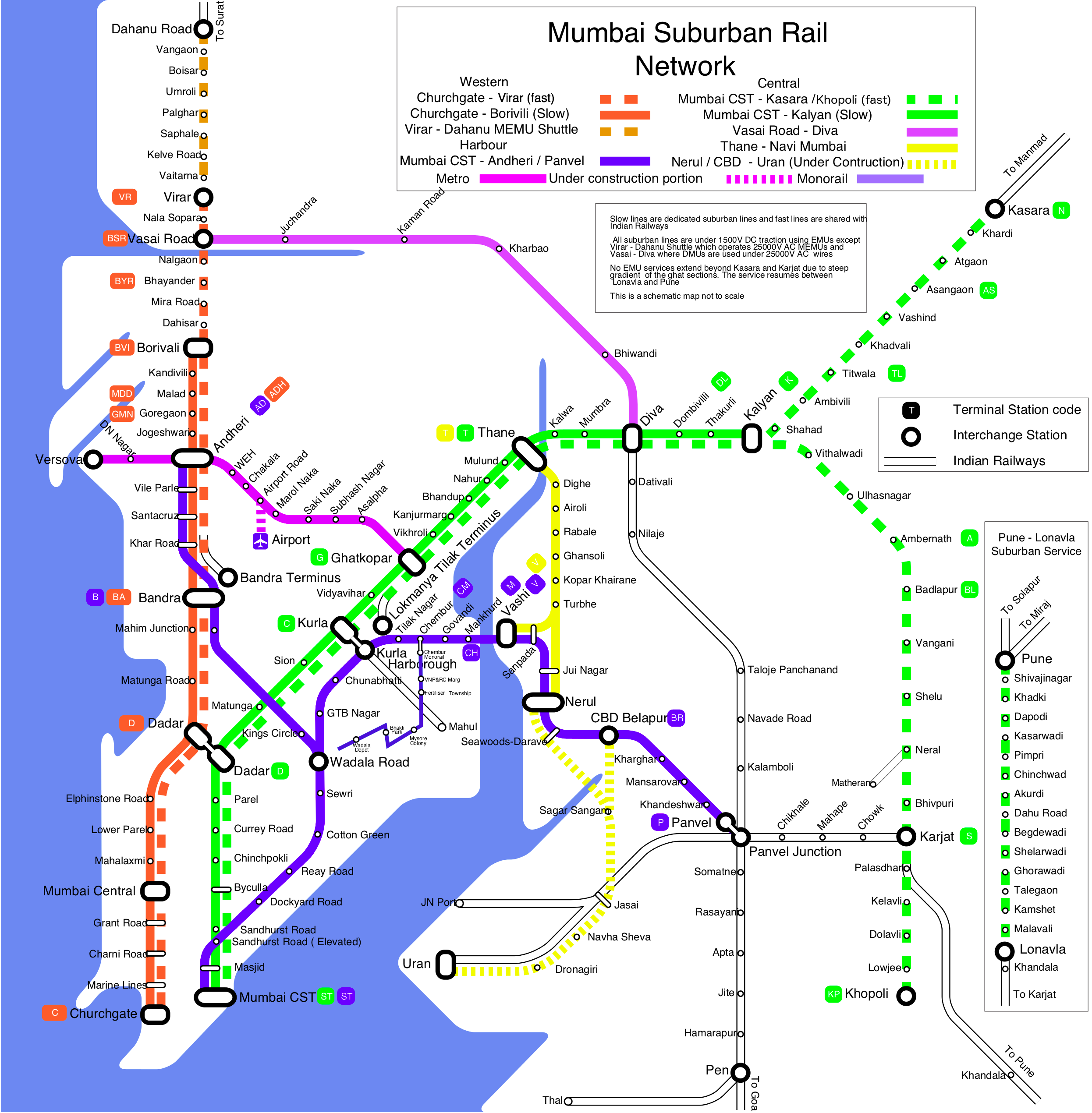
- Mumbai's local rail network, comprising of three trunk lines namely Western, Central and Harbour Lines with a total route length of 376 km, is the world's second busiest commuter rail system with an average daily ridership of around 6.2 million (2023). Ridership has decreased considerably during the last few years (7.6 m daily passengers in 2019-20). The first local train service was introduced in 1867 under the auspices of Bombay Baroda and Central Indian railway company. The line ran from Viraur to Back Bay. Central Railways (CR) carried ca 4.4 million daily commuters on 1 820 daily train services whereas Western Railways (WR) carried approx. 2.7 million passengers daily (1 414 daily train services as of Sep '26). 132 WR services are run with 15-car rakes as of Dec '22. The nominal capacity of a 15-car rake is around 6 000 compared to roughly 4 000 passengers for a 12-car rake. WR introduced 12-car and 15-car suburban rakes in 1986 and 2009 respectively.
The MUTP (Mumbai Urban Transport Project) 3A phase with an estimated expenditure of ₹ 337 b approved by the Cabinet Committee on Economic Affairs in Mar '19 will include laying of 5/6th lines between Borivali and Virar stations on the Western Line for dedicated suburban train usage, extension of the Harbour Line up to Borivali and a new signalling system on all three suburban lines. Stations will also be modernised. Procurement of new AC rakes at an estimated cost of ₹ 164 b has also been earmarked.- The first phase of the Nerul-Uran line from Kharkopar (Ulwe) to Nerul and Belapur was inaugurated in Nov '19. The section covers a distance of 12 km and is served by 40 daily EMU services. The second phase of the 27 km Nerul-Uran line is under construction.
The first AC suburban train in India was inducted into limited service in late '17 providing six up and down weekday services on the WR Churchgate-Borivali/Virar section. WR operates 147 weekday AC train services (ca 10 % of all WR services) as of Sep '26. CR operates 92 AC train services on the Main Line and 28 AC train services between CSMT and Vashi aand Panvel.
Mumbai local rail map >>
Urban Train Timetables (CR,WR, Harbour Line, Thane-Vashi-Panvel, Metro, Monorail)

Kolkata Suburban Rail Network
- Greater Kolkata and the surrounding region is connected by an extensive urban rail network provided by Eastern Railway (ER) and South Eastern Railway (SER). Sealdah (ER) Station is the terminus for many services operated east of the Hooghly River and reaching Bangaon close the Bangladesh border north east of the city, Krishnanagar to the north, Diamond Harbour to the south and the buffer areas of the Sundarbans terminating at Canning. A 35 km loop line (Circular Railway) encircles the central area of the city. The Howrah section (SER) operates EMU services to Haldia (port and industrial town), Digha (beach resort, Kharagpur, Jhargram and towns to the north/northwest such as Bardhaman and Bandel located on the Hoogly river.
An average 1 511 (ER 1 336 and SER 175 services) daily suburban train services catered over 3 million (ER ca 2.7 m and SER ca 0.4 m) daily passengers in 2014-15. Suburban train services recommenced in Nov '21 and are allowed to operate at 50 % of (seating) capacity. ER operates more than 920 and over 480 daily train services in the Sealdah and Howrah divisions respectively. SER operates approx. 50 daily train services in its Kharagpur division with the number of services to be increased to 104 by Nov 8 and thereafter to 147 train services (up and down).
Kolkata Suburban Rail Timetables (ER and SER)
Chennai Suburban Rail Network
- Chennai has an extensive suburban EMU rail network extending some 300 km comprising of three lines operated by the Southern Railways zone of Indian Railways. The network carried 1.07 million daily passengers in 2016-17. The number of daily suburban train services amounted to 592 at the end of Mar '17. Dedicated suburban lines include: The South Line from Beach to Tambaram (MEMU services extend over 160 km to Villupuram Junction), the West Line from Central Station to Tiruvallur (MEMU services extend up to Jolarpet, 213 km from Chennai Central) and Central Station to Gummidipoondi (North Line) used by approx. 120 000 daily commuters. MEMU services on the North Line extend up to Bitragunta in neighbouring Andhra Pradesh. The Beach-Tambaram line is the most heavily used service of the three lines.
Chennai Suburban Rail Timetables -
Chennai Mass Rapid Transit System (MRTS)
- The 19.3 km 18 station MRTS line is partly elevated and compliments the suburban rail network of Chennai. The line extends from Chennai Beach to Velachery with 132 daily train services carrying approx. 100 000 passengers on weekdays. The elevated line is being extended, albeit at a slow pace (end '22 is the latest estimate for completion of the phase II segment) mainly due to litigation issues, to St Thomas Mount. This five km extension from Velachery, with two intermediate stations, would be interconnected with the Chennai Green Metro line at St. Thomas Mount station.
-
Hyderabad Multi-Modal Transport System (MMTS)
- The MMTS suburban rail network covers a distance of 43 km over three lines and 27 stations. Trains run from Falaknuma to Lingampalli via Secunderabad, Falaknuma to Nampally and Nampally to Lingampalli. A separate suburban train operates from Secunderabad to Manoharabad. MMTS daily ridership is approx. 160 000. Phase II, which is under construction, will extend the present rail network by 90 km.
Other Rail Related Links
- Indian Railway Stations Development Corp. Ltd.
- Rail Vikas Nigam Ltd.
- IRFCA (Indian Railways Fan Club Association)
- National Rail Museum
- Indian Steam Railway Society
- Central Organisation for Railway Electrification
Indian Railway Equipment Manufacturers
- Kinet Railway Solutions
- Manufacturer of Vande Bharat sleeper trains.
- Alstom India
- Alstom operates a rolling stock (metro cars) plant at Sri City (Andhra Pradesh). Alstom also manufactures electric locomotives at its plant located at Madhepura (Bihar) with an initial contract for the manufacturing of 800 units of 9 000 KW "Prima" range of locomotives. The locomotives are expected to be delivered by Mar '28 with 650 units delivered as of Aug '26. A follow-on order for 200 locomotives is also a possibility.
- GE
- General Electric is setting up a diesel locomotive plant at Marhowra (Bihar) for the manufacturing of 1000 Evolution Series locomotives over a period of 11 years.
- Titagarh Wagons Ltd., Titagarh/Uttarpara (West Bengal)
- Bombardier Transportation India Ltd., Savli near Vadodara (Gujarat)
- Chittaranjan Locomotive Works (CLW)
- CLW, located at Chittaranjan (West Bengal) and commissioned in 1950, has manufactured 2 351 steam, 842 diesel and 7 603 electric locomotives till Mar '21. CLW was in fact the world's largest producer of electric locos having produced 700 units in a single year (2024/25). Electric locomotives produced include the 6 000 hp WAP-5P and 6 350 hp WAP-7 series units.
- Banaras Locomotive Works (BLW), Banaras (U.P) - BLW (erstwhile DLW) ever since releasing the first diesel locomotive in 1964 has produced thousands of diesel locos of various classes and more recently electric locos.
- Dahod Loco Manufacturing Shop (Gujarat) - was commissioned in May 2025 coinciding with the rollout of the first 9 000 HP Siemens Mobility electric locomotive manufactured at Dahod.
- Integral Coach Factory (ICF), Perambur (Tamil Nadu) is the largest railway coach manufacturer in the world. The facility rolled out 3 101 coaches (incl. 1 954 LHB coaches of which 1 394 were AC coaches and 15 Vistadome coaches) in 2021-22
- Rail Coach Factory, Kapurthala (Punjab) - RCF manufactured a record 151 LHB (Linke-Hofmann-Busch) coaches in July '20. IR inducted the first LHB coaches (initially imported from Germany) into service in 2000 and the first RCF manufactured coaches in 2003. ICF also manufactures LHB coaches.
- Modern Coach Factory, Raebareli (U.P) - MCF (commisioned in 2014) manufactured 1 360 passenger coaches (6 000 till Nov '20) incl. Tejas sleepers, Humsafar, Antyodaya and Deen Dayalu coaches/rakes.
- Marathwada Rail Coach Factory located in Latur (Maharashta) is the most recently commissioned rail coach factory in India. The facility is planned to have an annual manufacturing capacity of 250 MEMUs.
- Bharat Heavy Electicals Ltd. (BHEL)
- Jessop & Co. Ltd, Kolkata
- Bharat Earth Movers Ltd. (BEML), Bengaluru
- Manufactures rail coaches
- Rail Wheel Factory, Bengaluru
- Diesel Loco Modernisation Works, Patiala
- Railtel Corp. of India Ltd.
- Rail Wheel Factory - Yelahanka (Karnataka)
Research and Development
- RDSO Research, Designs & Standards Organisation
Mountain Trains
- Darjeeling Himalaya Railway
- A narrow gauge toy train connecting New Jalpaiguri and Darjeeling.
The Darjeeling toy train at New Jalpaiguri ready to embark on its 6½ hr journey to Darjeeling - © youtube.com/indiavideo
- World Heritage Tour panographies >>
NHK World Heritage video >>


Darjeeling toy train loco at New Jalpaiguri - Kalka-Shimla
- This 96 km long narrow gauge rail line was built in 1903 requiring a lot engineering skills. The longest of the 103 tunnels found on this line is over 1.1 km long at an altitude of 1500 meters.
- Nilgiri Mountain Train
- Nilgiri Mountain Train (or Blue Mountain) connects Mettupalayam with Udhagamandalam (Ooty) traversing a distance of 45.88 km on a metre gauge rail track . A special rack and pinion system (the only one of its kind in India) keeps the train from slipping down and negotiate the steep gradient while moving up.
- Neral - Matheran
- Neral, situated 96 km from Mumbai, is the starting point for the two foot gauge rail track toy train to the renowned hill station of Matheran (alt. 2650 ft).
Special Tourist Trains
- The Golden Chariot
- A luxury train that covers major sights of Karnataka including stops at Bengaluru, Mysore, Kabini, Hassan, Hampi and neighbouring Goa.
- Heritage on Wheels
- A meter gauge luxury train that covers the Rajasthani destinations of Jaipur, Bikaner, Tal Chhapar amd Shekhawati
- Palace on Wheels
- Route: Delhi-Jaipur-Chittaurgarh-Udaipur-Jaisalmer-Jodhpur-Bharatpur-FatehpurSikri-Agra-Delhi
- The Royal Orient train
- The Royal Orient covers many interesting points in Rajasthan and Gujarat during the seven day journey departing from Delhi.
- The Steam Express
- The Fairy Queen locomotive, manufactured in 1854, is probably the oldest running steam loco in the world. The loco, hauling a tourist train, runs monthly (Oct-Apr) between Delhi and Alwar.
- Deccan Odyssey
- A Luxury tourist train service covering the following route: Mumbai-Ratnagiri-Sindhudurg-Goa-Pune-Aurangabad-Nashik-Mumbai